801-797-2297
1414 South 600 West, Bountiful, UT 84010
Mon-Friday, 8am-5pm
801-797-2297 | Mon-Friday, 8am-5pm

Welcome to Our Blog: Vasolabs News and Education

Flavors of Medicine: Conventional, Integrative, Functional, and Everything in Between
Flavors of Medicine: Conventional, Integrative, Functional, and Everything in Between
Most people think medicine is one thing. You go to the doctor, you get advice, maybe a prescription, maybe some labs, and you move on. The truth is more interesting. Modern healthcare is a spectrum. Different models approach the same problem from different angles, and each one carries strengths, blind spots, and its own philosophy.
Think of it like restaurants. They all serve food, but what you order, how it is prepared, and how long you stay at the table changes depending on where you go. The same is true with medicine. Today we will walk through the most common flavors of care. We will translate the jargon, strip away the noise, and show you how each model thinks about root causes, medications, supplements, nutrition, and imaging. Along the way you will see brief case style examples so you can understand how a patient’s journey might look inside each approach.
This is not a ranking. It is a guide so you can see the entire landscape clearly.
Conventional Medicine
This is the model most people know. It is built on standardized training, clear protocols, lab driven decisions, and medications that have been tested in large studies. The focus is diagnosis and treatment. When a patient has a clear disease or a measurable abnormality, conventional medicine shines.
A conventional doctor thinks in terms of patterns. Your symptoms point toward a possible diagnosis. Your labs confirm or rule out that diagnosis. From there, treatment begins. This model uses medications confidently because they have been studied in thousands of people. It also uses imaging when needed to uncover hidden disease.
When it comes to root causes, this model looks for identifiable biological problems. High blood pressure is not treated as a mystery of lifestyle. It is treated as a measurable risk factor that needs a clear plan.
Diet and supplements are usually secondary. They matter, but most conventional clinics focus on what can be measured and corrected quickly with tools known to work.

Case example
Maria is forty seven and visits her conventional doctor because she feels tired. Her physician orders labs. They reveal anemia from low iron. She receives iron supplements and is screened for the cause. Her energy improves in six weeks. The process is efficient and direct.
Integrative Medicine
Integrative medicine sits in the middle of the spectrum. It accepts all the tools of conventional medicine but adds lifestyle, nutrition, and mind body strategies. It does not reject medications. It simply views them as one tool in a larger toolbox.
The philosophy is simple. Treat the whole person, not just the lab value. An integrative doctor will ask about sleep, stress, environment, movement, and diet. They will explore how these pieces interact with your symptoms. They may use supplements and herbal support when appropriate, but they also lean on evidence based treatments when the situation calls for it.
Integrative medicine aims to build long term resilience. Instead of only treating the diagnosis, it tries to strengthen the body’s ability to function well. It acknowledges that biology does not operate in separate boxes. Everything influences everything.
Case example
David is fifty five with stubborn high blood pressure. His integrative doctor reviews his diet, stress levels, and sleep. They discover he drinks three cups of coffee on an empty stomach and sleeps five hours a night. He receives a mild dose of medication for short term control while also addressing sleep, sodium intake, and stress habits. Two months later his medication dose is reduced because his lifestyle is carrying more of the load.
Functional Medicine
Functional medicine focuses heavily on root causes. It asks why something is happening. It looks for patterns across systems such as the gut, hormones, immune function, and metabolism. It uses extensive lab testing to look for imbalances that might be contributing to symptoms.
This model spends more time on lifestyle than any other. It views diet as central. It uses supplements for targeted support, sometimes in high detail. The goal is restoration of normal function rather than control of disease through medication. Functional providers often build plans that include elimination diets, stress reduction strategies, detoxification support, and advanced nutrient testing.
Functional medicine can feel slower because the focus is on deep repair rather than quick relief. It works best for chronic issues without clear answers.
Imaging is used when needed but is not always the first choice. The emphasis is on systems biology rather than structural findings.

Case example
Sofia is thirty eight and has chronic digestive issues, fatigue, and brain fog. Her functional provider runs advanced stool testing and checks for nutrient deficiencies. They discover low B vitamins, disrupted gut bacteria, and high stress hormones. Her plan includes a specific diet, probiotics, targeted supplements, and stress reduction practices. Three months later she reports improved digestion and better focus. Her progress is gradual but meaningful.
Everything in Between: Hybrid and Lifestyle Focused Care
There are clinics and practitioners who do not fit neatly into any category. Some cardiology practices blend advanced imaging with lifestyle guidance. Some internal medicine physicians use conventional tools but also coach patients on diet and metabolic health. Some longevity clinics use supplements and cutting edge labs but still rely on medications when proven to reduce risk.
This hybrid model is growing because patients want personalized care. They want the certainty of conventional medicine plus the depth of lifestyle focused approaches. A good hybrid clinician knows when to push deeper and when to keep things simple.
These providers tend to use imaging strategically. For example, cardiac focused practices may use carotid IMT to track early plaque. Endocrine oriented practices may use continuous glucose monitors to help patients understand sugar control. These tools help patients visualize their progress and become active participants in prevention.

Case example
Michael is sixty one and worried about his heart. His hybrid clinician orders a carotid IMT scan along with advanced cholesterol labs. The scan shows early plaque. His plan includes a statin at a low dose, omega 3 support, specific dietary guidelines, and a walking program. A year later his IMT follow up shows improved arterial health. The combination of medication and lifestyle changes created a measurable change.
Choosing the Model That Fits You
There is no single correct model. The right choice depends on your goals, your personality, and your current health status.
If you want quick answers, clear diagnoses, and evidence based medication strategies, conventional medicine will feel familiar and reliable.
If you want a broader view that blends lifestyle and science, integrative medicine may be a good fit.
If your symptoms are chronic, vague, or resistant to standard approaches, functional medicine may help you uncover contributing factors.
If you want tools from every model, hybrid care offers the most flexibility.

The key is to understand the strengths of each approach so you can choose rather than guess.
Good medicine is not a competition. It is a layered system of ideas and tools. The most successful patients are the ones who understand the landscape well enough to navigate it with confidence.

Why should you get this C-IMT scan?
Informed patients make better decisions.

Early Detection of Heart Disease Risk
A C-IMT scan can act as an early warning system by identifying increased thickness in the artery walls long before any symptoms of heart disease or stroke become evident.

Personalized Treatment Plan
The results of a C-IMT scan can help your doctor tailor a treatment plan to reduce your risk of heart attack or stroke, which is the leading cause of death and disability in the world.

Non-Invasive and Safe
Unlike some other tests, the C-IMT scan is non-invasive and uses ultrasound, not radiation. It's safe and doesn't require any special preparation.

Family History
If you have a family history of early heart disease or stroke, the scan can provide valuable information about your own risk, helping you and your doctor to take preventive measures.

Peace of Mind
If you are anxious about your cardiovascular health, a vasometric scan can provide reassurance if your results are within a normal range.
Vasolabs Is A Premier Provider Of Safe, Convenient Heart Disease Screenings.
Vasolabs Is A Premier Provider Of Safe, Convenient Heart Disease Screenings.
Uses the newest ultrasound technology
Determines whether or not you have heart disease
Pain-free. Requires no wires, treadmills, or needles.
Takes only 15 minutes
Get your Easy-to-Understand Report within 24 hours
Optional Discussion with your Clinician
Schedule a test to see if you’re at risk of heart disease!
Identify Your Risks of Getting Cardiovascular Disease With a Simple C-IMT Scan!
Know if You Are at Risk for Heart Attacks, Strokes, and other Cardiovascular Diseases:
$499 $249
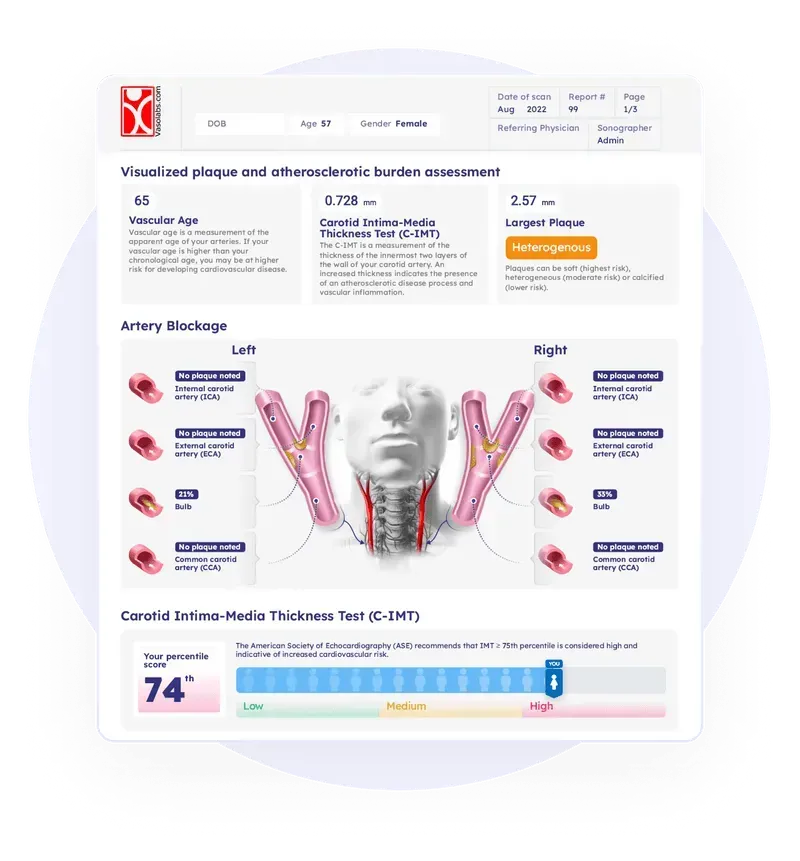
What's Included in your Report:
See your Vascular Age!
Soft or Calcified Plaque is visualized, you’ll see it all.
Track Your inflammation, Know your Artery Blockage.
Informed patients make better decisions.
Loved ones depend on you.
Do I Need a Heart Screening?
Here is a checklist of factors that put you at elevated risk for heart attack, stroke, and other forms of cardiovascular disease:
Over 40 years of age
Family history of heart disease/stroke
Overweight
Increased cholesterol level
High-fat diet
Tobacco user
High blood pressure
Diabetic
Metabolic syndrome
Erectile dysfunction
Psoriasis
Peace of Mind is Priceless

Looking back, it's chilling to realize how close I came to the edge. I opted for a test at Vasolabs on a whim, without any particular symptoms. Boy, am I glad I did! Turns out, my arteries were nearly clogged up - something regular doctors wouldn't have caught unless there were signs of a problem. By the time I got a couple of second opinions and returned to my regular doctor, my arteries were 95% blocked. If I hadn't taken the test when I did, I could have had a stroke. Trust me when I say this, going to Vasolabs was one of the best decisions I've ever made.
- George B
I was really worried about getting a heart attack because its already happened in our family. So taking this test gave me the peace of mind I was looking for. And it was so cool to see the age of my artery was younger than I was!!
- Barbara L.
I went to Vasolabs for their C-IMT testing, thinking it'd be a complicated deal, but nope! It was as easy as getting a photo taken. And guess what? They found an issue that could've been a silent threat. Thanks to them catching it early, my doctor and I are on top of it now. Honestly, I feel like I dodged a bullet. Big thumbs up for Vasolabs!
- Walter S.
I saw an ad on Facebook and I got the C-IMT Test for myself and my husband, it was such an easy process. And a great gift idea for family. It was really fun to look at the results and good to know I need to work on my health.
- Jessica F.
Frequently Asked Question
What is a C-IMT scan?
A C-IMT Scan is a non-invasive procedure that uses ultrasound technology to measure the thickness of your carotid arteries' walls. These arteries, located on each side of your neck, supply blood to your brain. Over time, plaque can build up in these arteries, causing them to thicken. This is often an early sign of atherosclerosis, a disease that can lead to serious conditions such as heart attacks and strokes.
Where do I go to get this scan?
For your quick, 15-minute appointment, simply head over to our facility located at 1414 South 600 West, Bountiful, UT 84010.
Who takes my test?
Dean Ence, an expert sonographer, will be handling your fast, no-pain test to figure out the 'age' of your arteries. This test checks how thick your artery walls are - thicker walls can mean inflammation. It's all simplified for you to understand easily. We also spot and show plaque, whether soft or hard, in your arteries. You get detailed pictures from the ultrasound for your records. Taking care of your health is our main goal!
How long does the C-IMT Scan and Report take?
The duration of the C-IMT scan can vary depending on various factors, like the complexity of the patient's condition. Typically, a Vasometric scan takes around 15 minutes to complete. The report is done and delivered within 24 hours to you.
Will my insurance cover this C-IMT Scan?
No. Hospitals charge $800, but our cost is $249.

Our Mission:
Vasolabs is dedicated to promoting heart health by providing innovative, easy-to-access tests. We empower people with insights into their vascular health for early risk detection.


