801-797-2297
1414 South 600 West, Bountiful, UT 84010
Mon-Friday, 8am-5pm
801-797-2297 | Mon-Friday, 8am-5pm

Welcome to Our Blog: Vasolabs News and Education

The Best Forms of Magnesium for Cardiovascular Health
Not all magnesium is created equal
When it comes to heart and vascular health, the form of magnesium matters just as much as the dose. Different forms are absorbed differently, act on different systems, and provide distinct benefits.
Below are the most effective and commonly recommended forms of magnesium for cardiovascular support.
Magnesium glycinate
Best overall for heart health and tolerance
Magnesium glycinate is magnesium bound to the amino acid glycine. This form is highly bioavailable and gentle on the digestive system.
Cardiovascular benefits
Supports stable heart rhythm
Helps calm the nervous system and reduce stress related blood pressure spikes
Less likely to cause digestive discomfort
This is often the first choice for individuals with cardiovascular concerns or those sensitive to other forms.
Magnesium taurate
Excellent for blood pressure and heart rhythm
Magnesium taurate combines magnesium with taurine, an amino acid known for its cardiovascular benefits.
Cardiovascular benefits
Supports healthy blood pressure
Helps regulate heart rhythm
Supports vascular relaxation
This form is especially useful for individuals with hypertension or palpitations.
Magnesium malate
Supports energy production and muscle function
Magnesium malate is bound to malic acid, a compound involved in cellular energy production.
Cardiovascular benefits
Supports heart muscle energy metabolism
Helps reduce muscle fatigue
Useful for individuals with low energy or muscle soreness
While not heart specific, it supports the heart as a high energy demand muscle.
Magnesium citrate
Good absorption but not ideal for everyone
Magnesium citrate is well absorbed but has a mild laxative effect.
Considerations
Can support magnesium repletion
May cause loose stools at higher doses
This form may be useful short term but is often not ideal for long term cardiovascular supplementation.
Magnesium oxide
Not recommended for cardiovascular support
Magnesium oxide has poor absorption and primarily acts as a laxative.
Limitations
Low bioavailability
Minimal impact on magnesium blood levels
This form is commonly used due to low cost but offers limited cardiovascular benefit.
Choosing the right magnesium for heart health
For most individuals focused on cardiovascular support, the following are best:
Magnesium glycinate for overall heart rhythm and stress balance
Magnesium taurate for blood pressure and vascular health
Consistency matters more than high dosing. Magnesium works best when taken daily as part of a long term heart health strategy.
Final takeaway
Magnesium supports the electrical, muscular, and vascular systems that keep your heart functioning smoothly. Choosing a highly absorbable form is essential for real cardiovascular benefit.
For preventive heart care, magnesium is not a trend. It is a foundation.
References
DiNicolantonio JJ, O’Keefe JH, Wilson W.
Subclinical magnesium deficiency: a principal driver of cardiovascular disease and a public health crisis.
Open Heart. 2018.Zhang X et al.
Magnesium intake and cardiovascular disease mortality: a meta analysis of prospective cohort studies.
American Journal of Clinical Nutrition. 2012.Rosanoff A, Weaver CM, Rude RK.
Suboptimal magnesium status in the United States: are the health consequences underestimated?
Nutrition Reviews. 2012.Touyz RM.
Role of magnesium in the pathogenesis of hypertension.
Molecular Aspects of Medicine. 2003.Gröber U, Schmidt J, Kisters K.
Magnesium in preventio

Why should you get this C-IMT scan?
Informed patients make better decisions.

Early Detection of Heart Disease Risk
A C-IMT scan can act as an early warning system by identifying increased thickness in the artery walls long before any symptoms of heart disease or stroke become evident.

Personalized Treatment Plan
The results of a C-IMT scan can help your doctor tailor a treatment plan to reduce your risk of heart attack or stroke, which is the leading cause of death and disability in the world.

Non-Invasive and Safe
Unlike some other tests, the C-IMT scan is non-invasive and uses ultrasound, not radiation. It's safe and doesn't require any special preparation.

Family History
If you have a family history of early heart disease or stroke, the scan can provide valuable information about your own risk, helping you and your doctor to take preventive measures.

Peace of Mind
If you are anxious about your cardiovascular health, a vasometric scan can provide reassurance if your results are within a normal range.
Vasolabs Is A Premier Provider Of Safe, Convenient Heart Disease Screenings.
Vasolabs Is A Premier Provider Of Safe, Convenient Heart Disease Screenings.
Uses the newest ultrasound technology
Determines whether or not you have heart disease
Pain-free. Requires no wires, treadmills, or needles.
Takes only 15 minutes
Get your Easy-to-Understand Report within 24 hours
Optional Discussion with your Clinician
Schedule a test to see if you’re at risk of heart disease!
Identify Your Risks of Getting Cardiovascular Disease With a Simple C-IMT Scan!
Know if You Are at Risk for Heart Attacks, Strokes, and other Cardiovascular Diseases:
$499 $249
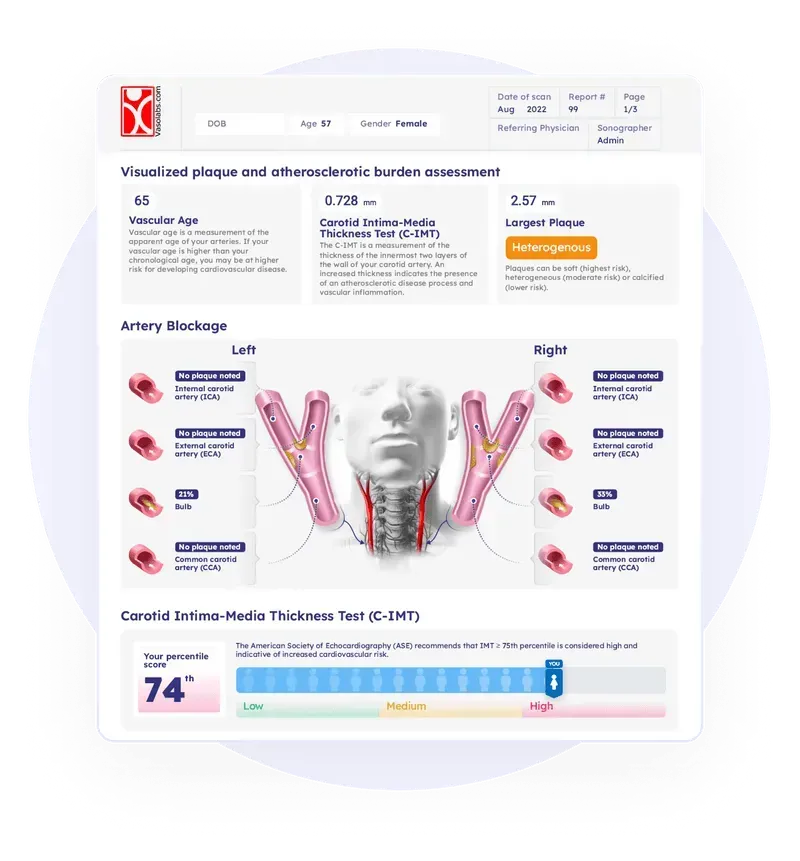
What's Included in your Report:
See your Vascular Age!
Soft or Calcified Plaque is visualized, you’ll see it all.
Track Your inflammation, Know your Artery Blockage.
Informed patients make better decisions.
Loved ones depend on you.
Do I Need a Heart Screening?
Here is a checklist of factors that put you at elevated risk for heart attack, stroke, and other forms of cardiovascular disease:
Over 40 years of age
Family history of heart disease/stroke
Overweight
Increased cholesterol level
High-fat diet
Tobacco user
High blood pressure
Diabetic
Metabolic syndrome
Erectile dysfunction
Psoriasis
Peace of Mind is Priceless

Looking back, it's chilling to realize how close I came to the edge. I opted for a test at Vasolabs on a whim, without any particular symptoms. Boy, am I glad I did! Turns out, my arteries were nearly clogged up - something regular doctors wouldn't have caught unless there were signs of a problem. By the time I got a couple of second opinions and returned to my regular doctor, my arteries were 95% blocked. If I hadn't taken the test when I did, I could have had a stroke. Trust me when I say this, going to Vasolabs was one of the best decisions I've ever made.
- George B
I was really worried about getting a heart attack because its already happened in our family. So taking this test gave me the peace of mind I was looking for. And it was so cool to see the age of my artery was younger than I was!!
- Barbara L.
I went to Vasolabs for their C-IMT testing, thinking it'd be a complicated deal, but nope! It was as easy as getting a photo taken. And guess what? They found an issue that could've been a silent threat. Thanks to them catching it early, my doctor and I are on top of it now. Honestly, I feel like I dodged a bullet. Big thumbs up for Vasolabs!
- Walter S.
I saw an ad on Facebook and I got the C-IMT Test for myself and my husband, it was such an easy process. And a great gift idea for family. It was really fun to look at the results and good to know I need to work on my health.
- Jessica F.
Frequently Asked Question
What is a C-IMT scan?
A C-IMT Scan is a non-invasive procedure that uses ultrasound technology to measure the thickness of your carotid arteries' walls. These arteries, located on each side of your neck, supply blood to your brain. Over time, plaque can build up in these arteries, causing them to thicken. This is often an early sign of atherosclerosis, a disease that can lead to serious conditions such as heart attacks and strokes.
Where do I go to get this scan?
For your quick, 15-minute appointment, simply head over to our facility located at 1414 South 600 West, Bountiful, UT 84010.
Who takes my test?
Dean Ence, an expert sonographer, will be handling your fast, no-pain test to figure out the 'age' of your arteries. This test checks how thick your artery walls are - thicker walls can mean inflammation. It's all simplified for you to understand easily. We also spot and show plaque, whether soft or hard, in your arteries. You get detailed pictures from the ultrasound for your records. Taking care of your health is our main goal!
How long does the C-IMT Scan and Report take?
The duration of the C-IMT scan can vary depending on various factors, like the complexity of the patient's condition. Typically, a Vasometric scan takes around 15 minutes to complete. The report is done and delivered within 24 hours to you.
Will my insurance cover this C-IMT Scan?
No. Hospitals charge $800, but our cost is $249.

Our Mission:
Vasolabs is dedicated to promoting heart health by providing innovative, easy-to-access tests. We empower people with insights into their vascular health for early risk detection.


